December 2025 — UK-Korea Researcher Exchange deepens collaboration in enzyme engineering
Daejeon, Republic of Korea
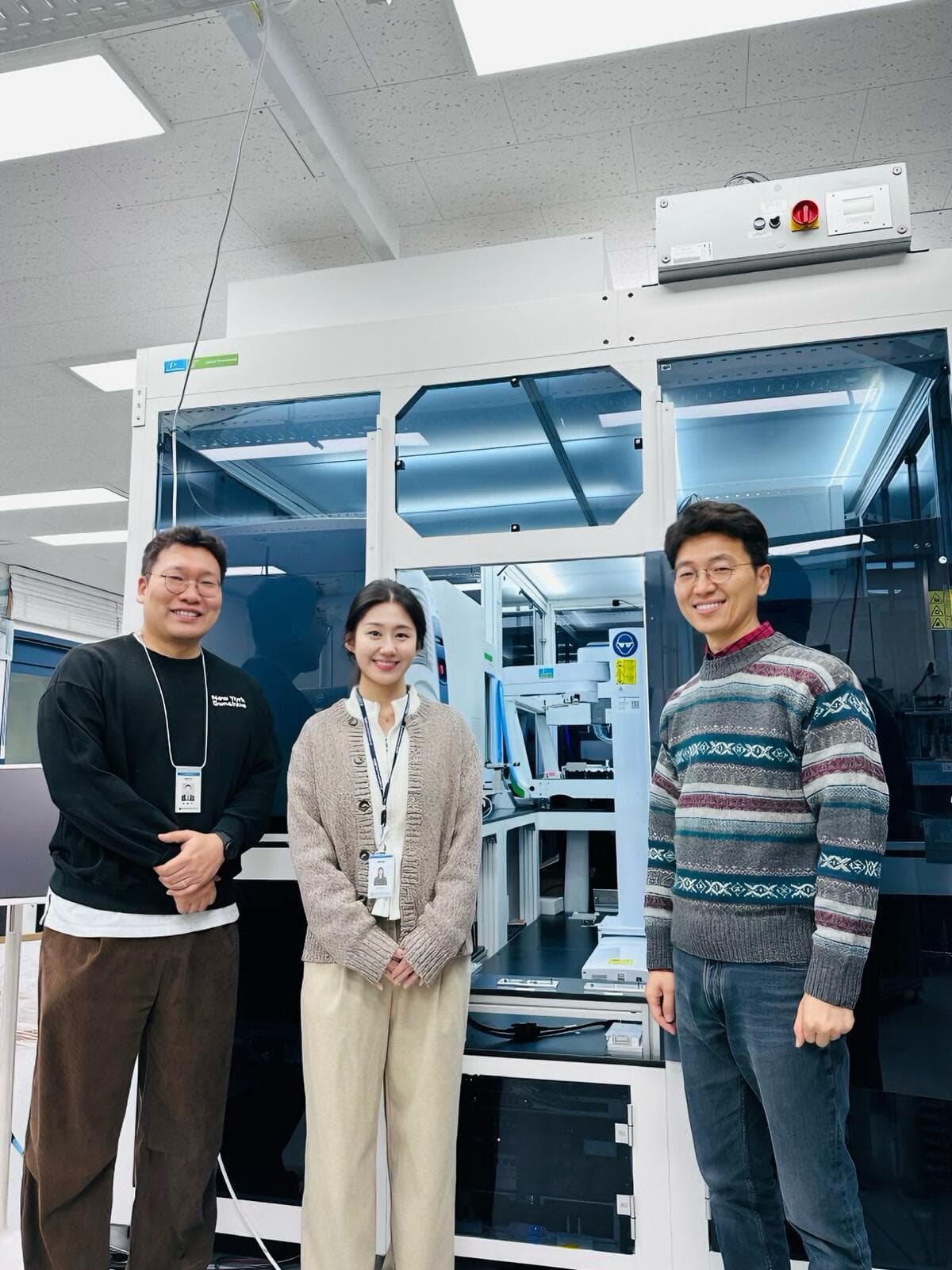
University of Manchester PhD student Ruiyi Yang shares her experience at KRIBB's Synthetic Biology Research Centre, working on enzyme engineering for sustainable biomanufacturing as part of the UK-Korea collaboration.
The University of Manchester PhD student Ruiyi Yang shares details of her experience as an exchange researcher at Korea Research Institute of Bioscience and Biotechnology (KRIBB), working in Synthetic Biology Research Centre as part of a UK-Korea collaboration in engineering biology and green catalysis.
What is the title of the project you are currently working on?
Organosilicon Compound Manipulation Using Engineered Enzymes: Design, Engineering, and Evolution of Novel Biocatalysts.
Silicones are indispensable in electronics, construction, automotive and medical applications, but conventional routes to silicone polymers still depend on corrosive, environmentally problematic chlorosilanes. In UK, under the supervision of Dr. Lu Shin Wong, I aim to develop greener strategies by using enzymes to catalyse polymerisation and depolymerisation at silicon-oxygen bonds, monitored by a high-throughput biosensor that reports the formation of reaction products when these bonds are cleaved. Building on a DmpR-based phenol biosensor previously developed at KRIBB, we are adapting this system to screen large libraries of enzymes.
My project builds directly on this idea. Working together with colleagues at KRIBB, I am:
- Constructing libraries of enzymes
- Coupling this biosensor to libraries of enzymes, so that each cell's fluorescence reports on its enzyme variant's activity.
- Establishing a high-throughput screening workflow to identify improved variants.
In practice, that means molecular cloning and assembly of the relevant biological parts, adjusting DmpR expression levels, and carefully comparing fluorescence readouts with chemical analyses of product formation. The overall aim is a low-leakage, wide-dynamic-range biosensor that can be used as a general platform for organosilicon enzyme evolution.
What do you plan to do next on this project, on return to the UK?
- Establish a robust high-throughput workflow to screen enzyme variants, including library preparation, cultivation formats, fluorescence measurement and sorting criteria.
- Sequence the lead candidate enzymes identified by the biofoundry high throughput platform and perform protein structure analysis.
- Small-scale reactor tests for silicone depolymerization.
What are the main differences in the facilities and ways of working between your host institution and home institution?
At the Manchester Institute of Biotechnology, there is a strong emphasis on enzymology, directed evolution and process-scale thinking. We have rich experience in designing and analysing directed-evolution campaigns, and very good access to high-throughput screening and analytical platforms.
KRIBB, and especially the Synthetic Biology Research Centre, is exceptionally strong in synthetic biology, precise gene-circuit engineering and high-throughput system. Here, the construction of genetic circuits is very precise, and the power of synthetic biology is visible in how carefully each regulatory element is designed and tested.
Working in both environments lets me view the same project from two complementary angles. Doing research in Manchester Institute of Biotechnology encourages me to think about mechanism, kinetics and industrial relevance, while KRIBB shows me how a well-engineered genetic circuit and screening pipeline can unlock those mechanistic questions at scale. Together, they form a very powerful combination for enzyme engineering and green catalysis.
What have you enjoyed most so far during your time at KRIBB?
Life in Korea itself has been very interesting. The atmosphere in the lab is warm and cohesive; people are kind, collaborative, and genuinely invested in each other's projects. Watching how colleagues design and refine high-throughput screening workflows here, I sometimes feel I am seeing the early stages of industrial-scale implementation being built inside an academic setting.
On the technical side, it is very satisfying to be exposed to different research areas and to experience how each new topic enriches my own technical perspective. Every experiment teaches me something new about gene expression, host physiology, biosensor behaviour, or measurement noise.
Beyond the bench, I really appreciate the kindness and patience of everyone in the group. They introduced me to Korean food, local routines, and ways of balancing long experiments with life outside the lab, and they share the "hidden tips" that never appear in methods sections. These experiences are helping me think more deeply about how research cultures shape the questions we ask and the solutions we design.
What are you hoping to do next in your career?
I am still in the middle of my PhD, so my plans are evolving, but one thing is clear: I would like to continue working at the interface of enzyme engineering, synthetic biology and green chemistry. Projects like this biosensor-guided evolution of organosilicon hydrolases show how molecular-level design can connect to very practical sustainability challenges.
In the future, I hope to become an independent scientist who can design not only better enzymes, but also better workflows and collaborations around them -- linking high-throughput data generation, computation, and process development. For now, my main goal is to make this UK-Korea project as successful as possible, and to transfer the skills I gained from both Manchester and KRIBB into whatever I do next.