September 2026 – PhD students from South Korea undertake biosynthesis research while on placement at Imperial College London
London, UK
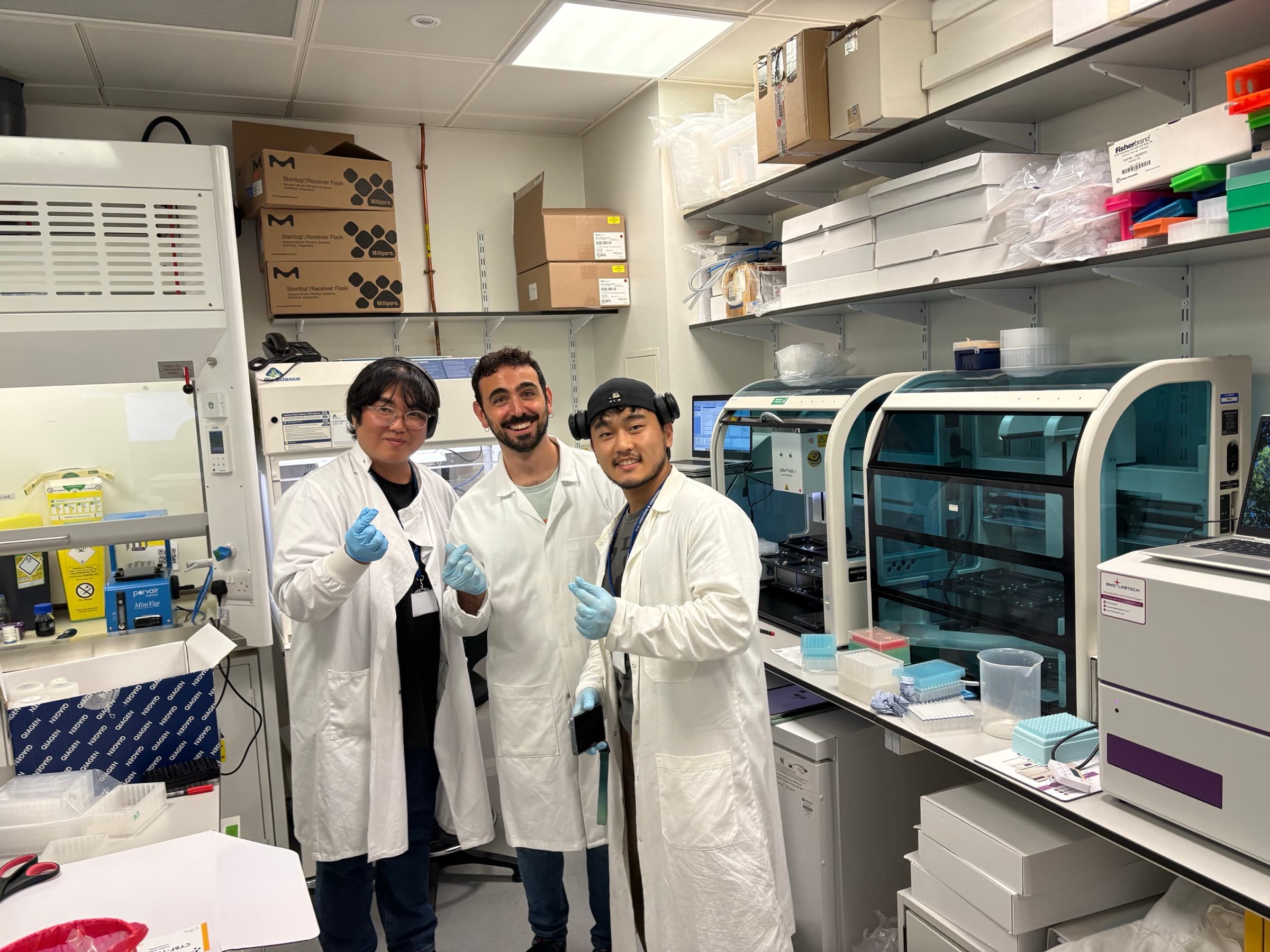
Hongki Kim, PhD student from the Korea Advanced Institute of Science and Technology (KAIST), reflects on his recent research placement with the London Biofoundry.
Hongki Kim, PhD student from the Korea Advanced Institute of Science and Technology (KAIST), reflects on his recent research placement with the London Biofoundry.
What is the objective of the project you are currently working on?
Project title: Integrating Cell-Free Synthetic Biology with High-Throughput Automation for Natural Product Biosynthesis
Our research focuses on combining cell-free synthetic biology with high-throughput laboratory automation to accelerate the engineering and characterisation of biological systems, particularly those involved in natural product biosynthesis.
At KAIST, we are developing cell-free protein synthesis (CFPS) platforms using Streptomyces, a group of bacteria renowned for their ability to produce structurally diverse and biologically active natural products, including many antibiotics. Despite their enormous biosynthetic potential, discovering and engineering these compounds remains challenging. Many biosynthetic pathways involve large, multidomain enzymes, such as polyketide synthases (PKSs), which can be difficult to express, modify, and functionally characterise using conventional cell-based approaches.
Cell-free systems offer an alternative by allowing biological reactions to be conducted outside living cells, providing greater flexibility in controlling reaction conditions and introducing engineered components. Our work aims to establish a platform in which biosynthetic enzymes can be synthesised and functionally evaluated in a more modular and systematic manner.
However, developing a scalable platform requires more than optimising biological reactions. The ability to rapidly construct DNA libraries, prepare genetic components, and evaluate large numbers of experimental conditions is equally important.
This was a major motivation for our research exchange at Imperial College London.
During our visit, we explored high-throughput DNA assembly and automated molecular biology workflows, including liquid handling, bacterial transformation, colony picking, plasmid preparation, and DNA quantification. We also worked on constructing genetic parts with different promoter and ribosome binding site combinations, which are essential components for controlling gene expression.
An important aspect of the project was understanding how these individual procedures could be integrated into a more standardised and scalable experimental workflow. Working with automation systems also allowed us to identify practical challenges, such as DNA quality, liquid-handling consistency, and the compatibility of different experimental steps.
Ultimately, our objective is to connect automated DNA construction with cell-free expression and functional screening. By combining KAIST's expertise in Streptomyces-based biosynthetic systems with Imperial's experience in laboratory automation, we hope to contribute to the development of a more efficient and reproducible platform for engineering complex biosynthetic pathways.
What do you plan to do next on this project, on return to Korea?
Following our return to KAIST, our immediate priority is to apply the knowledge and experimental approaches we gained at Imperial to our ongoing research.
On the biological side, we will continue developing and optimising Streptomyces-based CFPS systems, with a particular focus on the synthesis and functional characterisation of polyketide synthases. These enzymes are attractive targets for cell-free synthetic biology because their large size, complex domain organisation, and requirements for post-translational modification make them particularly challenging to study.
We are interested not only in whether these enzymes can be successfully synthesised, but also in whether they retain their catalytic activity and can interact productively with other biosynthetic components. Establishing reliable methods to evaluate these properties will be essential for developing modular biosynthetic platforms.
In parallel, we plan to build upon the automation workflows explored during our time at Imperial. One of our longer-term goals is to establish a more integrated design–build–test workflow, in which genetic constructs can be designed, assembled, and experimentally evaluated with minimal repetitive manual handling.
For example, automated DNA assembly could enable the parallel construction of different promoter, ribosome binding site, or enzyme module combinations. These constructs could then be introduced into cell-free expression systems, where protein synthesis and biochemical activity could be measured using high-throughput assays.
This approach could be particularly valuable for studying modular PKSs, where screening different combinations of biosynthetic modules and their interaction interfaces can quickly become experimentally demanding.
At the same time, our experience at Imperial highlighted the importance of validating each step of an automated workflow rather than assuming that automation alone guarantees experimental success. Ensuring DNA quality, confirming construct identity, and maintaining consistency across multiple samples will therefore remain important priorities.
We also hope to maintain our collaboration with the researchers at Imperial through continued discussions, exchange of experimental protocols, and potential follow-up experiments.
In the longer term, we envision a research platform that combines biological engineering, cell-free reactions, and laboratory automation to accelerate the systematic exploration of natural product biosynthetic pathways.
What are the main differences in the facilities and ways of working between your host institution and home institution?
One of the most striking differences was how laboratory automation was incorporated into experimental workflows at Imperial.
At KAIST, much of our research has focused on developing and optimising biological systems, particularly cell-free expression platforms. This typically involves extensive experimental characterisation, such as adjusting reaction compositions, comparing biological extracts, and analysing biochemical performance.
Although automated instruments are also available at KAIST, our work at Imperial exposed us to a different approach in which multiple molecular biology procedures were organised around high-throughput and automated workflows.
During the exchange, we had the opportunity to work with instruments for automated liquid handling, colony picking, DNA preparation, and quantitative analysis. For instance, experiments that would conventionally be performed using individual tubes or small numbers of samples could be organised in 96-well formats, allowing larger sets of genetic constructs to be processed in parallel.
What was particularly interesting was that automation required us to think differently about experimental design.
In a conventional experiment, researchers can often make small adjustments during the procedure based on their observations. In an automated workflow, however, sample layouts, reaction volumes, reagent compatibility, and procedural sequences must be considered much more carefully in advance.
We also realised that a workflow is only as reliable as its individual steps. Small inconsistencies in DNA preparation, transformation efficiency, or colony selection can affect subsequent stages, especially when processing many samples simultaneously.
This experience reinforced the importance of standardisation, quality control, and troubleshooting in high-throughput biological research.
Another difference was the opportunity to work closely with researchers who specialised in different aspects of the experimental process. Discussions with colleagues experienced in automation and molecular biology helped us approach technical challenges from perspectives that were sometimes different from our usual approaches.
Rather than viewing the two institutions as having entirely different ways of conducting research, we came to appreciate how their respective strengths could complement each other.
Our experience at KAIST has provided a strong foundation in understanding and engineering biological systems, while our time at Imperial demonstrated how these systems might be studied more efficiently through automated and scalable experimentation.
Combining these two perspectives is something we hope to carry forward in our research.
What have you enjoyed most so far during your time at your host institution?
One of the most enjoyable aspects of our exchange was the opportunity to experience how research is conducted in a different laboratory and scientific environment.
Although we were working on scientific questions closely related to our research at KAIST, many aspects of the experimental process were new to us. Learning to operate unfamiliar instruments, adapting existing protocols to automated workflows, and working through unexpected experimental challenges made the experience both demanding and rewarding.
We particularly enjoyed the process of learning from researchers with different areas of expertise. The exchange gave us opportunities to discuss not only the scientific objectives of our experiments, but also practical considerations such as workflow design, troubleshooting, and experimental reproducibility.
These interactions often helped us reconsider approaches that we had previously taken for granted.
We also appreciated the welcoming and supportive atmosphere of the research group. Our colleagues were generous with their time, whether helping us learn new equipment, discussing experimental results, or simply sharing their experiences of research life at Imperial.
Outside the laboratory, spending time with the team and experiencing life in London were also memorable parts of the visit. These informal interactions made it easier to build connections and helped us feel part of the research community rather than simply temporary visitors.
Perhaps the most valuable lesson was that international research collaboration involves much more than exchanging scientific results.
Even when researchers share similar goals, differences in technical expertise, experimental practices, and ways of thinking can lead to new ideas and approaches. Experiencing these differences firsthand helped us develop a broader perspective on how research can be conducted.
The exchange also reminded us that unsuccessful experiments and unexpected results can be valuable learning opportunities, particularly when they lead to a better understanding of experimental limitations and more robust approaches.
Overall, what we appreciated most was the combination of scientific learning, collaborative problem-solving, and the personal connections we developed during our time at Imperial.
What are you hoping to do next in your career?
We both hope to continue working in synthetic biology and biological engineering, with a particular interest in developing technologies that enable biological systems to be designed, constructed, and characterised more efficiently.
One of the major challenges in synthetic biology is the gap between our ability to design biological systems and our ability to experimentally evaluate them at scale. Advances in DNA synthesis, computational design, and biological engineering have greatly expanded the range of systems we can construct, but experimental characterisation often remains time-consuming and labour-intensive.
We are particularly interested in approaches that help address this limitation by combining cell-free systems, high-throughput experimentation, and laboratory automation.
Cell-free synthetic biology provides a flexible environment for studying and engineering biological reactions, while automation can improve experimental throughput, consistency, and reproducibility. We believe that integrating these technologies has significant potential not only for natural product biosynthesis, but also for broader applications in biotechnology.
In the future, we hope to contribute to research that makes biological engineering more systematic and predictive, moving towards platforms in which large numbers of biological designs can be constructed, tested, and improved efficiently.
Our experience at Imperial has also strengthened our interest in interdisciplinary and international collaboration. Working with researchers from different scientific and technical backgrounds demonstrated how combining expertise can help address problems that would be difficult to solve within a single discipline.
Whether pursuing further research in academia or contributing to biotechnology research and development, we hope to remain involved in collaborative projects that connect fundamental biological understanding with practical engineering technologies.
Ultimately, our goal is to contribute to the development of tools and platforms that enable scientists to explore complex biological systems more effectively and accelerate the translation of biological discoveries into useful applications.