Exchange programme enables postdoc researcher from KAIST to collaborate with UK researchers at The University of Manchester.
Manchester, UK
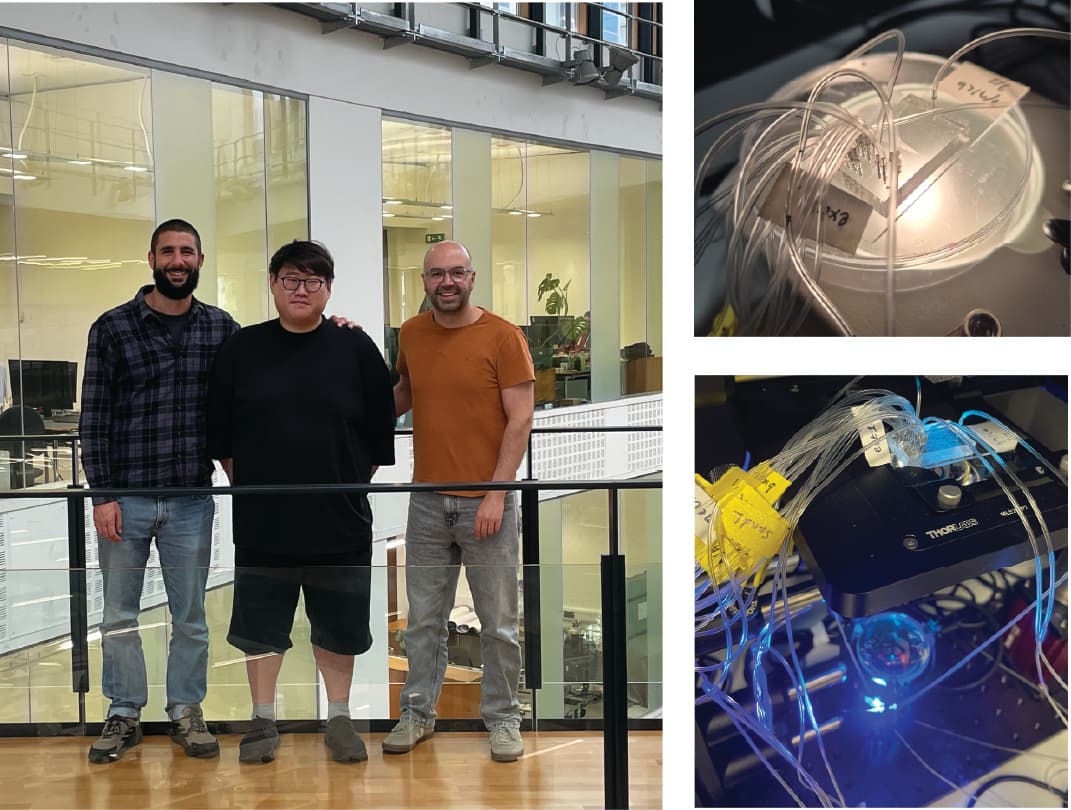
Dukwon Lee (centre), Postdoctoral Researcher from the Korea Advanced Institute of Science and Technology (KAIST), shares insights into his research collaboration with Dr Mato Lagator (left) and Dr Craig Markin (right) at The University of Manchester.
Dukwon Lee (centre), Postdoctoral Researcher from the Korea Advanced Institute of Science and Technology (KAIST), shares insights into his research collaboration with Dr Mato Lagator (left) and Dr Craig Markin (right) at The University of Manchester.
What is the objective of the project you are currently working on?
My current research focuses on engineering terminal deoxynucleotidyl transferase (TdT), an enzyme capable of synthesising DNA without a template. During my placement in Manchester, I focused specifically on engineering an auxiliary DNA-binding domain fused to TdT. By systematically modifying the surface charge of this domain, we aim to understand how DNA-binding properties can be tuned and ultimately use this knowledge to improve the performance of engineered TdT.
What do you plan to do next on this project, on return to South Korea?
A substantial part of the DNA-binding domain library has now been constructed, and the preliminary experiments have helped us establish how the library can be evaluated using the microfluidic platform in Dr Craig Markin’s lab. There are therefore materials and experimental results in Manchester that will allow the screening work to continue after my placement. I hope that Craig’s lab will be able to continue this work, but I would be even happier if I have an opportunity to return to the UK and continue some of these experiments myself. Back in Korea, I plan to continue engineering TdT and use what I have learned during this placement to further improve its DNA-binding and synthesis properties.
What are the main differences in the facilities and ways of working between your host institution and home institution?
One facility that particularly impressed me was the microfluidic protein-screening platform being developed in Craig’s lab. Craig himself often described the system as still being at an early stage of development, but I actually found that aspect particularly exciting. Rather than feeling like a finished and fixed system, it seemed to leave plenty of room for trying new ideas and developing the platform in different directions. What fascinated me most was its potential scale: using only a few microlitres of a cell-free expression reaction, the platform could potentially express proteins across around 1,500 individual wells and subsequently evaluate their properties on the same chip. Seeing this made it easy to imagine how powerful such a system could become for high-throughput protein engineering.
Beyond the facilities themselves, what impressed me most in Manchester was the research culture surrounding them. I found the environment remarkably open: researchers from different groups readily shared equipment, materials, expertise and, most importantly, ideas. Discussions between students, postdocs and PIs felt very natural, and it was easy to ask questions or approach someone from another group when an experiment required expertise I did not have. I also appreciated the strong attention given to researcher wellbeing, safety and creating an environment in which people can work sustainably. These aspects made the research environment both productive and genuinely enjoyable for me.
What have you enjoyed most so far during your time at your host institution?
I have most enjoyed the conversations. During my placement, I had many opportunities to discuss science with PIs and researchers with very different backgrounds, both within my host groups and across the MIB. I particularly enjoyed the open discussions during lab meetings, where people were comfortable questioning ideas, suggesting alternatives and constructively disagreeing with one another. Some of my most valuable experiences came simply from talking through an experimental problem or a new idea with other researchers. Being surrounded by people who were genuinely curious about each other’s work made my time in Manchester both scientifically productive and personally very enjoyable.
What are you hoping to do next in your career?
I would like to continue my career in research, with a particular focus on structure-guided protein and enzyme engineering. My background is in structural biology, and my current work has allowed me to increasingly apply that knowledge to engineering proteins with new or improved functions. I would like to continue developing at this interface between understanding molecular structure and using that understanding to design proteins. I am currently looking for opportunities to continue my postdoctoral research internationally, and after my experience here, I would be very happy if my career brought me back to the UK.